Poisson
Based on the following lectures
(1) “Statistics (2018-1)” by Prof. Sang Ah Lee, Dept. of Economics, College of Economics & Commerce, Kookmin Univ.
(2) "Statistical Models and Application (2024-1)" by Prof. Yeo Jin Chung, Dept. of Data Science, The Grad. School, Kookmin Univ.
(3) “Bayesian Modeling (2024-1)” by Prof. Yeo Jin Chung, Dept. of AI, Big Data & Management, College of Business Administration, Kookmin Univ.

definition
-
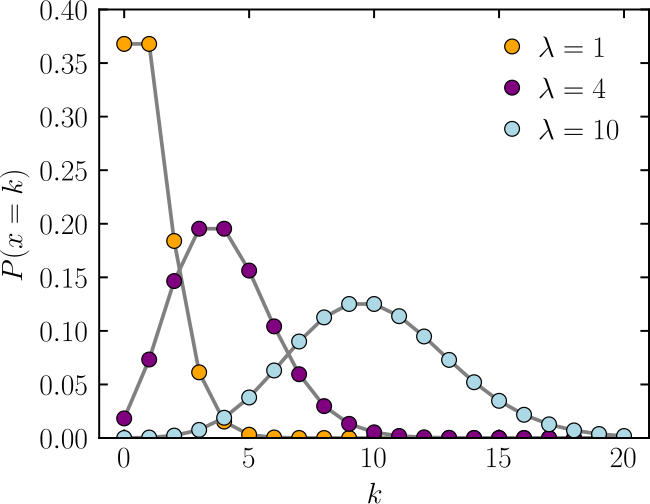
포아송 분포(Poisson Distribution): 단위 시간 혹은 영역 내에서 발생하는 사건 수를 나타내는 분포
\[X\sim\mathrm{Poisson}(\lambda),\quad X\in\mathbb{Z}\setminus\mathbb{Z}^{-}\]- $\lambda>0$: 단위 시간 당 평균 발생 횟수로서 스케일 파라미터의 역수
-
probability mass function:
\[\begin{aligned} p(x\mid\lambda) &=\frac{\lambda^{x}\exp{-\lambda}}{x!} \end{aligned}\] -
moment generating function:
\[\begin{aligned} M_{X}(t) &=\mathbb{E}_{p(x)}\left[\exp{tX}\right]\\ &=\sum_{x=0}^{\infty}{\exp{tx}\cdot\frac{\lambda^{x}\exp{-\lambda}}{x!}}\\ &=\exp{-\lambda}\sum_{x=0}^{\infty}{\frac{\left(\lambda\exp{t}\right)^{x}}{x!}}\\ \\ \because\exp{x} &=\sum_{k=0}^{\infty}{\frac{x^{k}}{k!}}\\ \sum_{x=0}^{\infty}{\frac{\left(\lambda\exp{t}\right)^{x}}{x!}} &=\exp{\left[\lambda\cdot\exp{t}\right]}\\ \\ \therefore M_{X}(t) &=\exp{-\lambda}\cdot\exp{\left[\lambda\cdot\exp{t}\right]}\\ &=\exp{\left[\lambda\left(\exp{t}-1\right)\right]} \end{aligned}\]- $\mathbb{E}\left[X\right]=(\mathrm{d}/\mathrm{d}t)M_{X}(t)\vert_{t=0}=\lambda$
- $\mathbb{E}\left[X^{2}\right]=(\mathrm{d}^{2}/\mathrm{d}t^{2})M_{X}(t)\vert_{t=0}=\lambda+\lambda^{2}$
- $\mathrm{Var}\left[X\right]=\mathbb{E}\left[X^{2}\right]-\mathbb{E}\left[X\right]^{2}=\lambda$
-
canonical form:
\[\begin{aligned} p(x) &=\frac{\lambda^{x}\exp{-\lambda}}{x!}\\ &=\frac{1}{x!}\exp{\left[x\log{\lambda}-\lambda\right]} \end{aligned}\]- $T(x)=x$
- $\eta(\theta)=\log{\lambda}$
- $A(\eta)=\lambda$
- $h(x)=1/x!$
conjugate prior
-
poisson model:
\[X\mid\lambda\sim\mathrm{Poisson}(\lambda)\] -
canonical form:
\[\begin{aligned} p(x\mid\lambda) &=\frac{\lambda^{x}\exp{-\lambda}}{x!}\\ &=\frac{1}{x!}\exp{\left[x\log{\lambda}-\lambda\right]} \end{aligned}\]- $T(x)=x$
- $\eta(\theta)=\log{\lambda}$
- $A(\eta)=\lambda$
- $h(x)=1/x!$
-
prior of $\eta$:
\[\begin{aligned} p(\eta) &\propto\exp{\left[\alpha\cdot\eta(\theta)-\beta\cdot A(\eta)\right]}\\ &=\exp{\left[\alpha\cdot\log{\lambda}-\beta\cdot \lambda\right]}\\ &=\exp{\left[\alpha\cdot\eta-\beta\cdot\exp{\eta}\right]} \end{aligned}\] -
change of variables $\eta\to\log{\lambda}$:
\[\begin{aligned} p_{\lambda}(\lambda)\mathrm{d}\lambda &=p_{\eta}(\eta)\mathrm{d}\eta\\ \therefore p_{\lambda}(\lambda) &=p_{\eta}(\log{\lambda})\left\vert\frac{\mathrm{d}\eta}{\mathrm{d}\lambda}\right\vert\\ &=\exp{\left[\alpha\cdot\log{\lambda}-\beta\cdot\lambda\right]}\cdot\frac{1}{\lambda}\\ &=\lambda^{\alpha-1}\exp{-\beta\lambda}\\ &\approx\mathrm{Gamma}(\alpha,\beta) \end{aligned}\] -
Therefore, rate parameter of poisson $\lambda$, average occurrence rate per unit time, follow gamma distribution. accordingly, $\alpha$ represents the number of events occurring, and $\beta$ represents the waiting time per event.
\[\lambda\sim\mathrm{Gamma}(\alpha,\beta)\]