DeepCF
Deng, Z. H., Huang, L., Wang, C. D., Lai, J. H., & Yu, P. S.
(2019, July).
Deepcf: A unified framework of representation learning and matching function learning in recommender system.
In Proceedings of the AAAI conference on artificial intelligence (Vol. 33, No. 01, pp. 61-68).

prior research
DMFXue, H. J., Dai, X., Zhang, J., Huang, S., & Chen, J. (2017, August). Deep matrix factorization models for recommender systems. In IJCAI (Vol. 17, pp. 3203-3209).- 표현 학습(Representation Learning)은 사용자와 아이템의 관계가 쌍선형(Bilinear)이라는 단순 가정 하에 엔티티들의 의미론적(Basis) 유사도를 반영하는 의미 체계(Linear Space, Latent Space)를 학습하는 데 강점이 있음
NCFHe, X., Liao, L., Zhang, H., Nie, L., Hu, X., & Chua, T. S. (2017, April). Neural collaborative filtering. In Proceedings of the 26th international conference on world wide web (pp. 173-182).- 매칭 함수 학습(Matching Function Learning)은 사용자와 아이템의 관계를 단순 가정으로 사전 제약하지 않고 데이터로부터 학습하여 데이터에 적합한 관계 구조를 모사하는 데 강점이 있음
idea
-
CFNet(
CollaborativeFilteringNetworks): 표현 학습 모듈(RepresentationLearningNetworks)과 매칭 학습 모듈(Matching FunctionLearningNetworks)을 병렬 결합하는 앙상블 모형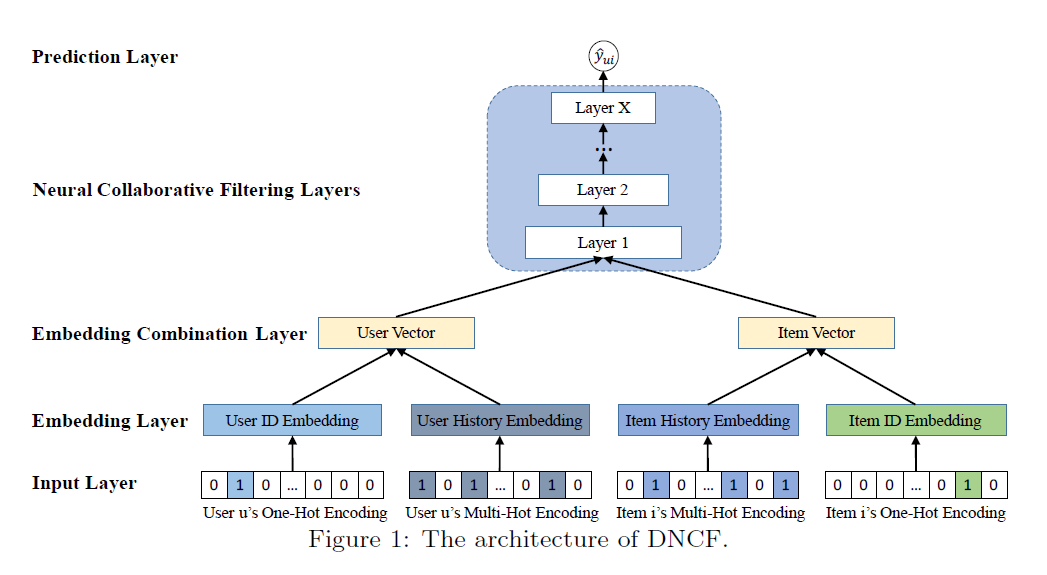
notation
- $u=1,2,\cdots,M$: user idx
- $i=1,2,\cdots,N$: item idx
- $\mathbf{Y} \in \mathbb{R}^{M \times N}$: user-item interaction matrix
- $\mathbf{u}_{u} \in \mathbb{R}^{K}$: user latent factor vector
- $\mathbf{v}_{i} \in \mathbb{R}^{K}$: item latent factor vector
- $\mathbf{z}_{u,i}$: predictive vector of user $u$ and item $i$
- $\hat{y}_{u,i}$: interaction probability of user $u$ and item $i$
function
-
\[\begin{aligned} \hat{y}_{u,i} &= \sigma\left(\mathbf{W}\cdot \left[\mathbf{z}_{u,i}^{\mathrm{(rl)}} \oplus \mathbf{z}_{u,i}^{\mathrm{(ml)}}\right]\right) \end{aligned}\]CFNetisRLNet&MLNetEnsemble
representation learning networks
-
user latent factor vector representation learning:
\[\begin{aligned} \mathbf{u}_{u} &=\mathrm{mlp}_{\mathrm{ReLU}}\left(\mathbf{Y}_{u*}\right) \end{aligned}\] -
item latent factor vector representation learning:
\[\begin{aligned} \mathbf{v}_{i} &=\mathrm{mlp}_{\mathrm{ReLU}}\left(\mathbf{Y}_{*i}\right) \end{aligned}\] -
bilinear interaction between user $u$ and item $i$:
\[\begin{aligned} \mathbf{z}_{u,i} &=\mathbf{u}_{u}\odot\mathbf{v}_{i} \end{aligned}\] -
if use
\[\begin{aligned} \hat{y}_{u,i} &=\sigma\left(\mathbf{W}\cdot\mathbf{z}_{u,i}\right) \end{aligned}\]CFNet-rlas a single prediction module:
matching function learning networks
-
generate user latent factor vector through linear transformation:
\[\begin{aligned} \mathbf{u}_{u} &=\mathbf{W}\cdot\mathbf{Y}_{u*} \end{aligned}\] -
generate user latent factor vector through linear transformation:
\[\begin{aligned} \mathbf{v}_{i} &=\mathbf{W}\cdot\mathbf{Y}_{*i} \end{aligned}\] -
predictive vector of user $u$ and item $i$:
\[\begin{aligned} \mathbf{z}_{u,i} &=\mathrm{mlp}_{\mathrm{ReLU}}\left(\mathbf{u}_{u}\oplus\mathbf{v}_{i}\right) \end{aligned}\] -
if use
\[\begin{aligned} \hat{y}_{u,i} &=\sigma\left(\mathbf{W}\cdot\mathbf{z}_{u,i}\right) \end{aligned}\]CFNet-mlas a single prediction module: