DELF
Cheng, W., Shen, Y., Zhu, Y., & Huang, L.
(2018, July).
DELF: A dual-embedding based deep latent factor model for recommendation.
In IJCAI (Vol. 18, pp. 3329-3335).
prior research
NCFHe, X., Liao, L., Zhang, H., Nie, L., Hu, X., & Chua, T. S. (2017, April). Neural collaborative filtering. In Proceedings of the 26th international conference on world wide web (pp. 173-182).- 암시적 피드백 데이터(implicit feedback)에서는 관측과 미관측이 반드시 선호 혹은 비선호를 나타낸다고 볼 수 없으나, 식별자 임베딩(index embedding)은 오로지 감독 신호(supervised signal)로부터 학습되므로 잡음(noise)이 섞여 있음
NSVDPaterek, A. (2007, August). Improving regularized singular value decomposition for collaborative filtering. In Proceedings of KDD cup and workshop (Vol. 2007, No. 2007, pp. 5-8).- 사용자 표현을 감독 신호(supervised signal)로부터 직접 추론하지 않고, 다른 사용자들과 공유되는 관측 아이템들을 집계하여 생성하므로 암시적 피드백 데이터(implicit feedback)의 잡음(noise)에 강건함
idea
-
DELF(
DualEmbedding based DeepLatentFactor Model): 아이디 임베딩과 히스토리 임베딩을 조합함으로써 다양한 정보원으로부터 다수의 매칭 함수를 병렬 학습하는 모형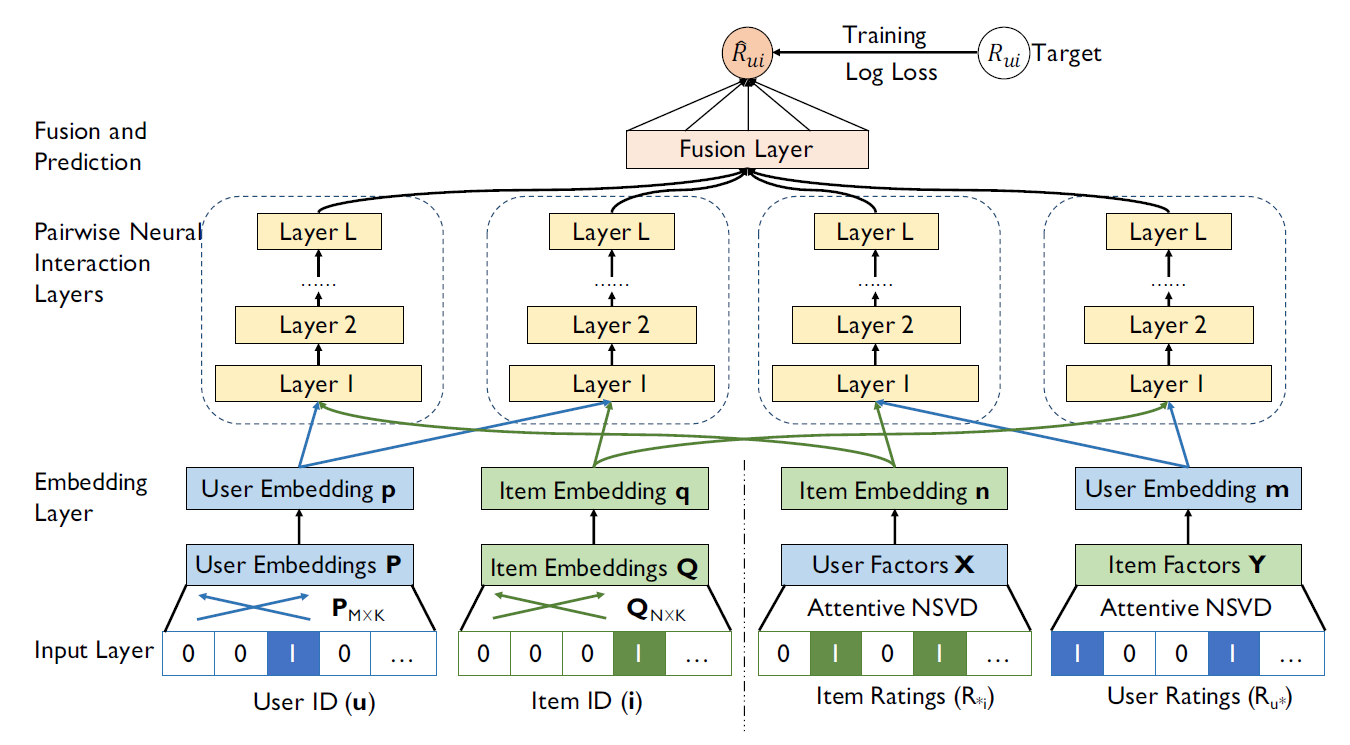
notation
- $u=1,2,\cdots,M$: user idx
- $i=1,2,\cdots,N$: item idx
- $\mathbf{X}^{\mathrm{(user)}} \in \mathbb{R}^{M \times M}$: user one-hot matrix
- $\mathbf{X}^{\mathrm{(item)}} \in \mathbb{R}^{N \times N}$: item one-hot matrix
- $\mathbf{Y} \in \mathbb{R}^{M \times N}$: user-item interaction matrix
- \(\mathbf{u}_{u},\mathbf{p}_{u} \in \mathbb{R}^{K}\): user ID embedding vector
- \(\mathbf{v}_{i},\mathbf{q}_{i} \in \mathbb{R}^{K}\): item ID embedding vector
- $\mathbf{m}_{u} \in \mathbb{R}^{K}$: user history embedding vector
- $\mathbf{n}_{i} \in \mathbb{R}^{K}$: item history embedding vector
- $\mathbf{h}^{\mathrm{(user)}},\mathbf{h}^{\mathrm{(item)}} \in \mathbb{R}^{1}$: global context vector
- $\mathbf{z}_{u,i}$: predictive vector of user $u$ and item $i$
- $\hat{y}_{u,i}$: interaction probability of user $u$ and item $i$
function
-
index embedding:
\[\begin{aligned} \mathbf{u}_{u},\mathbf{p}_{u} &=\mathbf{W}\cdot\mathbf{X}_{u*}^{\mathrm{(user)}}\\ \mathbf{v}_{i},\mathbf{q}_{i} &=\mathbf{W}\cdot\mathbf{X}_{u*}^{\mathrm{(item)}} \end{aligned}\] -
history embedding:
\[\begin{aligned} \mathbf{m}_{u} &=\mathrm{att}\left[\mathbf{h}^{\mathrm{(user)}},f(\mathbf{q}_{j}),\mathbf{q}_{j}\right],\quad\forall j \in \mathcal{R}_{u}^{+} \setminus \{i\}\\ \mathbf{n}_{i} &=\mathrm{att}\left[\mathbf{h}^{\mathrm{(item)}},f(\mathbf{p}_{v}),\mathbf{p}_{v}\right],\quad\forall v \in \mathcal{R}_{i}^{+} \setminus \{u\} \end{aligned}\] -
key transform function:
\[\begin{aligned} f(\phi) &=\mathrm{tanh}\left(\mathbf{W}\cdot\phi+\mathbf{b}\right) \end{aligned}\] -
pairwise neural interaction layers:
\[\begin{aligned} \mathbf{z}_{u,i}^{(1)} &=\mathrm{mlp}_{\mathrm{ReLU}}\left(\mathbf{u}_{u}\oplus\mathbf{v}_{i}\right)\\ \mathbf{z}_{u,i}^{(2)} &=\mathrm{mlp}_{\mathrm{ReLU}}\left(\mathbf{m}_{u}\oplus\mathbf{n}_{i}\right)\\ \mathbf{z}_{u,i}^{(3)} &=\mathrm{mlp}_{\mathrm{ReLU}}\left(\mathbf{u}_{u}\oplus\mathbf{n}_{i}\right)\\ \mathbf{z}_{u,i}^{(4)} &=\mathrm{mlp}_{\mathrm{ReLU}}\left(\mathbf{m}_{u}\oplus\mathbf{v}_{i}\right) \end{aligned}\] -
predict interaction probability of user $u$ and item $i$:
\[\begin{aligned} \hat{y}_{u,i} &= \sigma\left(\mathbf{W}\cdot\left[\mathbf{z}_{u,i}^{(1)}\oplus\mathbf{z}_{u,i}^{(2)}\oplus\mathbf{z}_{u,i}^{(3)}\oplus\mathbf{z}_{u,i}^{(4)}\right]+\mathbf{b}\right) \end{aligned}\]
This post is licensed under
CC BY 4.0
by the author.